Academic Writing & Publication Support
Our vision: Why academic writing and high-impact publications matter
In modern academia, writing is not a cosmetic add-on to research – it is the main way your work exists in the scientific community. Publications determine how hiring, promotion, funding, and collaborations are decided, and they strongly influence how your lab or clinic is perceived. Our team has extensive hands-on experience writing, revising, and publishing papers in leading international journals – including titles from the Nature portfolio, Cell Press, the American Chemical Society, Wiley, and Elsevier – and this experience, built through work and close collaborations with institutions such as Harvard Medical School and the University of Oxford, underpins everything we teach in academic writing and publication support.
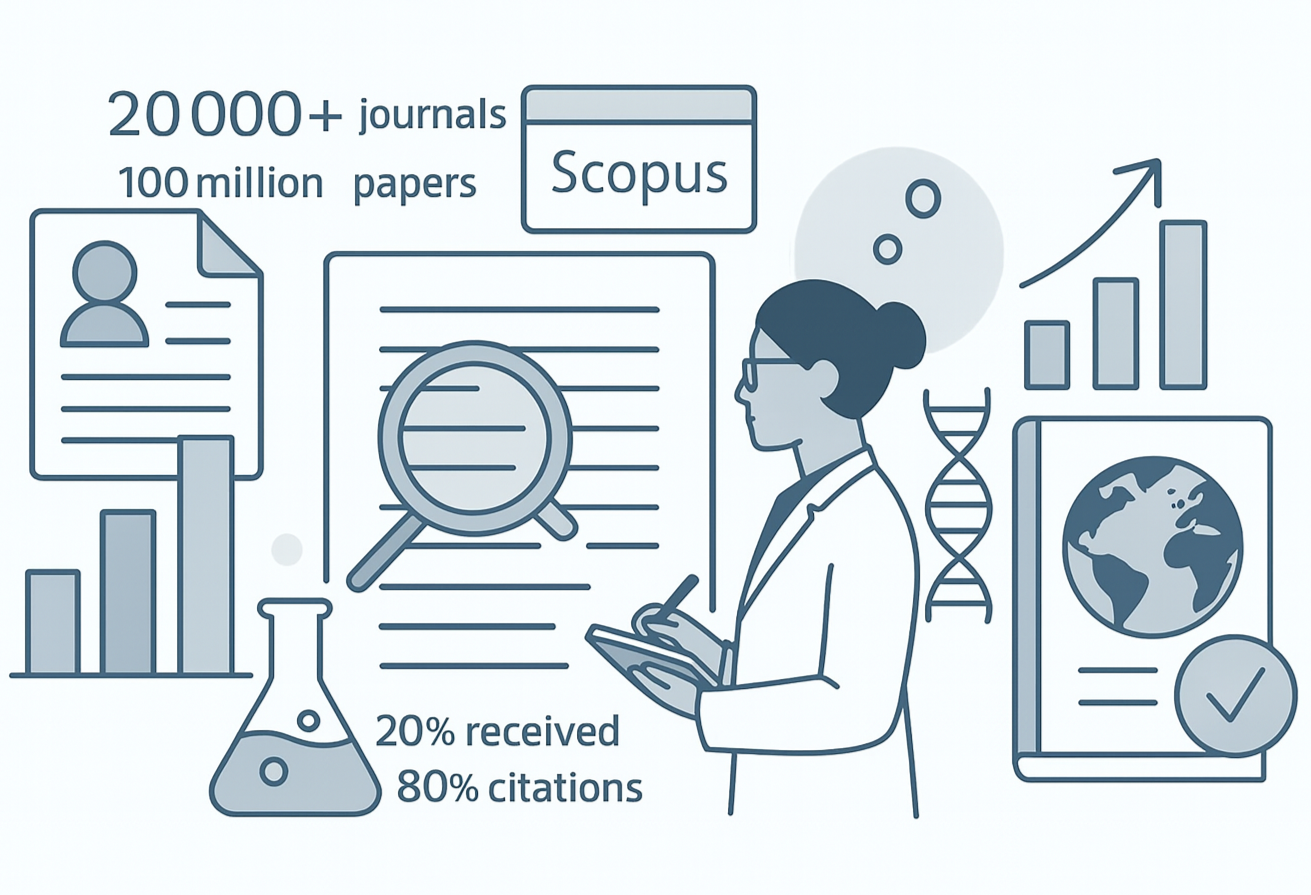
At the same time, the volume of scientific literature has become overwhelming. Scopus currently indexes well over 20,000 active peer-reviewed journals and over 100 million individual articles. No researcher can realistically follow this entire landscape, so in practice, scientists rely on a relatively small set of trusted, high-quality journals in their field. Bibliometric studies show a very skewed “80/20” pattern: a minority of papers, typically those in established, high-reputation journals, attract the majority of citations and attention, while most publications are rarely read or cited at all. They are technically “published”, but effectively invisible.
For an individual researcher, this means that generating good data is only half of the task. If your results are written unclearly, structured poorly, or published in an obscure outlet, there is a high risk that colleagues will never find or understand them. Even excellent experiments can then be forgotten in the archive, never driving new studies, never informing clinical decisions, and never helping real people. Conversely, when data are carefully shaped into a clear, coherent story and submitted to a journal with strong editorial standards and international visibility, they become part of the small fraction of literature that actually moves a field forward.
We therefore view presentation and dissemination of scientific results as being just as important as the experiments themselves. Good academic writing transforms local observations into shared knowledge; a thoughtful publication strategy connects that knowledge to the right community at the right time. Our programs are designed to help young scientists and clinicians master these skills: to describe their work with clarity and precision, to target reputable journals, and to build a publication record that both maximizes the real scientific impact of their research and opens concrete career opportunities worldwide.
Unlike many purely theoretical “academic writing” courses, our program is built around real-world practice. Its core is the Gold track: a six-month, workshop-style course where you learn academic writing by doing – step by step on a real manuscript based on your own or group data – with the clear, shared goal of submitting that paper to an appropriate Q1 journal by the end of the course.

Basic
Theory-focused academic writing course covering the full path from idea to publication, without joint manuscript writing.

Gold
Six-month group program where we guide you step by step to draft and submit one biomedical Q1-level manuscript by the end of the course.
Platinum
Intensive 1:1 mentoring to transform your own project or idea into a Q1-ready manuscript, with fully personalized feedback and pace.
Who is this for?
Our programs are designed for:
Master's, medical, and PhD students who want to publish their first Q1 paper.
Early-career clinicians with interesting clinical material but limited time or experience in writing.
Researchers with “sleeping” datasets, theses, or dissertations that have never been turned into manuscripts.
Departments, clinics, and research groups that want a systematic approach to training their teams in academic writing.
The primary focus is on biomedical topics, where our team has substantial research and publication experience (nanomedicine, gene therapy, cancer research, biomaterials, ophthalmology, etc.).
Our approach
We combine:
Structured teaching on how to design, write, and revise a high-quality manuscript.
Step-by-step guidance through all stages of preparing a paper, from selecting the journal to submission.
Continuous feedback on drafts, figures, and arguments.
Clear authorship principles: author order is discussed and determined based on the real contribution of each participant, in line with international authorship standards.
We aim to help you prepare a manuscript suitable for submission to a Q1 journal, but of course, no specific journal decision (accept/reject) can be guaranteed.
Program Options
Basic Track – Theory Only
50 € per month (6-month program)
This track is intended for participants who want to understand the full publication process but are not ready to commit to writing and submitting a manuscript during the course.
You will receive:
Regular online lectures and seminars on academic writing.
Detailed coverage of:
structure of a paper (IMRAD and beyond);
choosing a journal and reading its author guidelines;
building a logical scientific narrative;
common reasons for rejection and how to avoid them;
basics of responding to reviewers and revising a manuscript.
Practical examples from high-impact biomedical journals.
Q&A sessions, where you can ask questions about your own projects and ideas.
This track does not include joint manuscript development or submission as part of the program.
Gold Track – Group Manuscript Program
150 € per month (6-month program)
In the Gold Track, learning is directly linked to producing a manuscript as a group.
Duration: 6 months.
Group size: 3–8 participants.
By the end of the program, the goal is to have one manuscript prepared and submitted to an appropriate Q1 journal (primarily in biomedical fields).
During the program:
Each group works on a concrete manuscript under our supervision.
We cover all stages: concept, outline, drafting, figures, tables, references, journal selection, and submission.
If one or more participants already have experimental data (e.g., from a thesis, dissertation, or lab project), the group can build the manuscript around these data, provided the group agrees and the project fits the scope.
Authorship order is determined during the course according to the participants’ contributions (idea, data, writing, analysis, figures, revisions, etc.).
This track is ideal for small groups of students, residents, or early-career researchers who want to “convert” one substantial project into a high-quality paper while learning the process in depth.
Platinum Track – 1:1 Mentoring to Publication
300 € per month (6-month program)
The Platinum Track offers individual mentoring focused on your specific project and manuscript.
Duration: typically 6 months, with the possibility to adjust the timeline if needed.
Format: one-to-one work with personalized feedback on every step.
You receive:
Individual analysis of your project, data, and publication goals.
A tailored plan for preparing a manuscript suitable for submission to a Q1 journal.
Detailed feedback on every section of the manuscript (Introduction, Methods, Results, Discussion, Abstract, Figures, Cover Letter).
Flexibility in scheduling and pace: if the data are ready and you are able to dedicate sufficient time, the writing process can be compressed into a shorter period (but not less than one month, as preparing a serious manuscript requires substantial work).
As in all our programs, authorship is based on actual intellectual and practical contribution. We do not provide “ghostwriting”; instead, we work with you to ensure that you understand and control your own manuscript.
Data and authorship principles
All data and projects remain the intellectual property of the participants and their institutions.
We may be included as co-authors where our scientific and writing contribution meets commonly accepted authorship criteria.
Author order is discussed transparently during the course and reflects the real contribution of each participant.
We cannot guarantee acceptance in a specific journal; our role is to maximize the quality and coherence of the manuscript and to help you navigate the submission and revision process.
Institutional and group collaborations
We are open to collaborations with:
university departments,
hospitals and clinics,
research institutes,
biotech companies and startups
that wish to provide structured academic writing training for their teams (students, residents, fellows, or staff). Group packages and customized programs can be arranged on request.
How to join
If you are interested in any of the tracks (Basic, Gold, or Platinum), please contact us with:
your name and current position (student, resident, PhD, PI, etc.);
your field of interest;
whether you already have data or a project you would like to turn into a manuscript;
the track you are considering.
For inquiries and registration, please email: dr.alex.yar@gmail.com or use the contact form on the website.